Tampilkan postingan dengan label Sly and The Family Stone. Tampilkan semua postingan

Sly & The Family Stone - Dance To the Music (Good Funk US 1968)

Sabtu, 02 Maret 2013 1 komentar


Size: 112 MB
Bitrate: 256
mp3
Ripped by: ChrisGoesRock
Artwork Included
Source: Japan 24-Bit Remaster

Dance to the Music is the second studio album by funk/soul band Sly and the Family Stone, released April 27, 1968 on Epic/CBS Records. It contains the Top Ten hit single of the same name, which was influential in the formation and popularization of the musical subgenre of psychedelic soul and helped lay the groundwork for the development of funk music.

The Family Stone itself never thought very highly of Dance to the Music while they were recording it; its existence was the result of CBS executive Clive Davis' request for Sly Stone to make his sound more pop friendly. To appease his employer, Sly developed a formula for the band's recordings, which would still promote his visions of peace, brotherly love, and anti-racism while appealing to a wider audience. Most of the resulting Family Stone songs feature each lead singer in the band (Sly, Freddie Stone, Larry Graham, and newcomer Rose Stone) sharing the lead vocals by either singing them in unison or taking turns singing bars of each verse. In addition, the songs contained significant amounts of scat singing and prominent solos for each instrumentalist.

The formula not only worked in selling records, but influenced the entire music industry. When "Dance to the Music" became a Top 10 pop hit, R&B/soul producers and labels immediately began appropriating the new "psychedelic soul" sound. By the end of 1968, The Temptations had gone psychedelic, and The Impressions and Four Tops would join them within the space of two years. New acts such as The Jackson 5 and The Undisputed Truth would show heavy influence from Dance to the Music and its follow-ups, Life and Stand!. Many of the songs on this album (particularly the title track, "Are You Ready", "Ride the Rhythm", and the selections that make up the "Dance to the Medley" that closes Side A) adhere closely to the formula, and also share chord progressions. Exceptions include "Color Me True", a more somber selection about how one fits in with society, Sly's solo number "Don't Burn Baby", and "I'll Never Fall in Love Again", a slow ballad sung by Larry Graham. Also included is the band's first Epic single, "Higher" (later reworked as "I Want to Take You Higher"), and a rerecording of their only release for Loadstone Records, "I Ain't Got Nobody".


Sly and the Family Stone Biography:
Sly and the Family Stone were an American rock, funk, and soul band from San Francisco. Active from 1967 to 1983, the band was pivotal in the development of soul, funk, and psychedelic music. Headed by singer, songwriter, record producer, and multi-instrumentalist Sly Stone, and containing several of his family members and friends, the band was the first major American rock band to have an "integrated, multi-gender" lineup.

Brothers Sly Stone and singer/guitarist Freddie Stone combined their bands (Sly & the Stoners and Freddie & the Stone Souls) in 1967. Sly and Freddie Stone, trumpeter Cynthia Robinson, drummer Gregg Errico, saxophonist Jerry Martini, and bassist Larry Graham completed the original lineup; Sly and Freddie's sister, singer/keyboardist Rose Stone, joined within a year. This collective recorded five Billboard Hot 100 hits which reached the top 10, and four ground-breaking albums, which greatly influenced the sound of American pop music, soul, R&B, funk, and hip hop music. In the preface of his 1998 book For the Record: Sly and the Family Stone: An Oral History, Joel Selvin sums up the importance of Sly and the Family Stone's influence on African American music by stating "there are two types of black music: black music before Sly Stone, and black music after Sly Stone". The band was inducted into the Rock and Roll Hall of Fame in 1993.

During the early 1970s, the band switched to a grittier funk sound, which was as influential on the music industry as their earlier work. The band began to fall apart during this period because of drug abuse and ego clashes; consequently, the fortunes and reliability of the band deteriorated, leading to its dissolution in 1975. Sly Stone continued to record albums and tour with a new rotating lineup under the "Sly and the Family Stone" name from 1975 to 1983. In 1987, Sly Stone was arrested and sentenced for cocaine use, after which he went into effective retirement.

1968 Advertise

Career:
Sly Stone (born Sylvester Stewart, March 15, 1944) was a member of a deeply religious middle-class household from Dallas, Texas. K.C. and Alpha Stewart held the family together under the doctrines of the Church of God in Christ (COGIC) and encouraged musical expression in the household. After the Stewarts moved to Vallejo, California, the youngest four children (Sylvester, Freddie, Rose, and Vaetta) formed "The Stewart Four", who released a local 78 RPM single, "On the Battlefield of the Lord" backed with "Walking in Jesus' Name", in 1952.

While attending high school, Sylvester and Freddie joined student bands. One of Sylvester's high school musical groups was a doo-wop act called The Viscaynes, in which he and a Filipino teenager were the only non-white members. The Viscaynes released a few local singles, and Sylvester recorded several solo singles under the name "Danny Stewart".

By 1964, Sylvester had become Sly Stone, a disc jockey for San Francisco R&B radio station KSOL, where he included white performers such as The Beatles and The Rolling Stones into his playlists. During the same period, he worked as a record producer for Autumn Records, producing for San Francisco-area bands such as The Beau Brummels and The Mojo Men. One of the Sylvester Stewart-produced Autumn singles, Bobby Freeman's "C'mon and Swim", was a national hit record. Stewart recorded unsuccessful solo singles while at Autumn.

Early years:
In 1966, Sly Stone formed a band called Sly & the Stoners, which included acquaintance Cynthia Robinson on trumpet. Around the same time, Freddie founded a band called Freddie & the Stone Souls, which included Gregg Errico on drums, and Ronnie Crawford on saxophone. At the suggestion of Stone's friend, saxophonist Jerry Martini, Sly and Freddie combined their bands, creating Sly and the Family Stone in March 1967. Since both Sly and Freddie were guitarists, Sly appointed Freddie the official guitarist for the Family Stone, and taught himself to play the electronic organ. Meanwhile, Sly recruited Larry Graham to play bass guitar.
UK Promo Single 1968

Vaetta Stewart wanted to join the band as well. She and her friends, Mary McCreary and Elva Mouton, had a gospel music group called The Heavenly Tones. Sly recruited the teenagers directly out of high school to become Little Sister, Sly and the Family Stone's background vocalists.

After a gig at the Winchester Cathedral, a night club in Redwood City, CA, CBS Records executive David Kapralik signed the group to CBS' Epic Records label. The Family Stone's first album, A Whole New Thing, was released in 1967 to critical acclaim, particularly from musicians such as Mose Allison and Tony Bennett. However, the album's low sales restricted their playing venues to small clubs, and caused Clive Davis and the record label to intervene. Some musicologists[who?] believe the Abaco Dream single "Life And Death In G & A", recorded for A&M Records in 1967 and peaking at No. 74 in September 1969, was performed by Sly and the Family Stone.

Davis talked Sly into writing and recording a hit record, and he and the band reluctantly provided the single "Dance to the Music". Upon its February 1968 release, "Dance to the Music" became a widespread ground-breaking hit, and was the band's first charting single, reaching No. 8 on the Billboard Hot 100. Just before the release of "Dance to the Music", Rose Stone joined the group as a vocalist and a keyboardist. Rose's brothers had invited her to join the band from the beginning, but she initially had been reluctant to leave her steady job at a local record store.

The Dance to the Music album went on to decent sales, but the follow-up, Life, was not as successful commercially . In September 1968, the band embarked on its first overseas tour, to England. That tour was cut short after Graham was arrested for possession of marijuana, and because of disagreements with concert promoters.

Sound, philosophies, and influence:
Sly Stone had produced for and performed with black and white musicians during his early career, and he integrated music by white artists into black radio station KSOL's playlist as a D.J. Similarly, the Sly and the Family Stone sound was a melting pot, or stew, of many influences and cultures, including James Brown proto-funk, Motown pop, Stax soul, Broadway showtunes, and psychedelic rock music. Wah-wah guitars, distorted fuzz basslines, church-styled organ lines, and horn riffs provided the musical backdrop for the vocals of the band's four lead singers. Sly Stone, Freddie Stone, Larry Graham, and Rose Stone traded off on various bars of each verse, a style of vocal arrangement unusual and revolutionary at that time in popular music. Cynthia Robinson shouted ad-libbed vocal directions to the audience and the band; for example, urging everyone to "get on up and 'Dance to the Music'" and demanding that "all the squares go home!"
UK Single 1968

The lyrics for the band's songs were often pleas for peace, love, and understanding among people. These calls against racism, discrimination, and self-hate were underscored by the lineup for an on-stage appearance of the band. Caucasians Gregg Errico and Jerry Martini were members of the band at a time when integrated performance bands were virtually unheard of; integration had only recently become enforced by law. Females Cynthia Robinson and Rosie Stone played instruments onstage, rather than just providing vocals or serving as visual accompaniment for the male members. The band's gospel-styled singing endeared them to black audiences; their rock music elements and wild costuming—including Sly's large Afro and tight leather outfits, Rose's blond wig, and the other members' loud psychedelic clothing—caught the attention of mainstream audiences.[unreliable source?]

Although "Dance to the Music" was the band's only hit single until late 1968, the impact of that single and the Dance to the Music and Life albums reverberated across the music industry. The smooth, piano-based "Motown sound" was out; "psychedelic soul" was in. Rock-styled guitar lines similar to the ones Freddie Stone played began appearing in the music of artists such as The Isley Brothers ("It's Your Thing") and Diana Ross & the Supremes ("Love Child"). Larry Graham invented the "slapping technique" of bass guitar playing, which became synonymous with funk music. Some musicians changed their sound completely to co-opt that of Sly and the Family Stone, most notably Motown in-house producer Norman Whitfield, who took his main act The Temptations into "psychedelic soul" territory starting with the Grammy-winning "Cloud Nine" in 1968. The early work of Sly and the Family Stone was also a significant influence on the music of Michael Jackson, soul/hip-hop groups such as George Clinton & Parliament-Funkadelic, Arrested Development, and The Black Eyed Peas, among others.

Stand! (1969):
In late 1968, Sly and the Family Stone released the single "Everyday People", which became the band's first number-one hit. "Everyday People" was a protest against prejudices of all kinds, and popularized the catchphrase "different strokes for different folks." With its b-side "Sing a Simple Song", it served as the lead single for the band's fourth album, Stand!, which was released on May 3, 1969. The Stand! album eventually sold more than three million copies; its title track peaked at number 22 in the U.S. Stand! is considered one of the artistic high points of the band's career; it contained the above three tracks as well as the songs "I Want to Take You Higher", which also appeared on the b-side of the "Stand!" single, "Don't Call Me Nigger, Whitey", "Sex Machine", and "You Can Make It If You Try".

The success of Stand! secured Sly and the Family Stone a performance slot at the landmark Woodstock Music and Art Festival. The band performed their set during the early-morning hours of August 17, 1969; their performance was said to be one of the best shows of the festival. A new non-album single, "Hot Fun in the Summertime", was released the same month and went to number two on the U.S. pop charts (peaking in October, after the summer of 1969 had already ended). In 1970, following the release of the Woodstock documentary, the single of "Stand!" and "I Want to Take You Higher" was reissued with the latter song now the a-side; it reached the Top 40.

Internal problems and a change of direction:
With the band's new-found fame and success came numerous problems. Relationships within the band were deteriorating; there was friction in particular between the Stone brothers and Larry Graham. Epic requested more marketable output. The Black Panther Party demanded that Sly replace Gregg Errico and Jerry Martini with black instrumentalists and fire manager David Kapralik.

After moving to the Los Angeles area in fall 1969, Sly Stone and his fellow band members became heavy users of illegal drugs, primarily cocaine and PCP. As the members became increasingly focused on drug use and partying (Sly Stone carried a violin case filled with illegal drugs wherever he went), recording slowed significantly. Between summer 1969 and fall 1971, the band released only one single, "Thank You (Falettinme Be Mice Elf Agin)" / "Everybody Is a Star", released in December 1969. "Thank You" reached the top of the Billboard Hot 100 in February 1970. [Wikipedia]

Early Discography:
• 1967: A Whole New Thing (3 Stars)
• 1968: Dance to the Music (3 Stars)
• 1968: Life (4,5 Stars)
• 1969: Stand! (5 Stars)
• 1971: There is a Riot Going On (5 Stars)

AMG Rating Stars (AMG: http://www.allmusic.com)

01."Dance To The Music" – 3:00 
02."Higher" – 2:49 
03."I Ain't Got Nobody (For Real)" – 4:26 
04."Dance To The Medley": – 12:12 
•  "Music Is Alive" 
•  "Dance In" 
•  "Music Lover" 
05."Ride the Rhythm" – 2:48 
06."Color Me True" – 3:10 
07."Are You Ready" – 2:50 
08."Don't Burn Baby" – 3:14 
09."I'll Never Fall in Love Again" – 3:25

Bonus Tracks:
10."Dance to the Music" (mono single version) [2:57] 
11."Higher" (mono single version)[2:53] 
12."Soul Clappin'" [2:38] 
13."We Love All" (previously unreleased) [4:30] 
14."I Can't Turn You Loose" (previously unreleased) [3:33] 
15."Never Do Your Woman Wrong" (previously unreleased instrumental) [3:33] 

1. Link
or
2. Link
.

Sly & The Family Stone - There's a Riot Goin' On (US 1971)

Kamis, 07 Februari 2013 0 komentar


Size: 137 MB
Bitrate: 256
mp3
Ripped by: ChrisGoesRock
Artwork Included
Source: Japan 24-Bit Remaster

There's a Riot Goin' On is the fifth studio album by American funk and soul band Sly and the Family Stone, released November 20, 1971 on Epic Records. Recording sessions for the album took place primarily throughout 1970 to 1971 at Record Plant Studios in Sausalito, California.

In contrast to their previous studio work with psychedelic soul, as featured on Stand! (1969), There's a Riot Goin' On embraces a darker, more foreboding funk sound, while also rejecting the band's successful melodic formula that was featured on their previous hit singles. The original title of the album was intended to be Africa Talks to You, but was retitled There's a Riot Goin' On in response to Marvin Gaye's landmark album What's Going On (1971), which was released five months prior to Riot.

There's a Riot Goin' On debuted at number-one on the Billboard Pop Albums and Soul Albums charts upon its release, while the album's lead single, "Family Affair" (1971), topped the Pop Singles chart. On November 8, 1972, There's a Riot Goin' On was certified gold by the Recording Industry Association of America, for shipments of 500,000 copies in the US. It went on to ship 1 million copies, earning a platinum certification by the RIAA on September 7, 2001.

After an ambivalent reaction upon its release, the album's critical standing has improved significantly, leading to its praise as one of the greatest and most influential recordings of all time. There's a Riot Goin' On has also been ranked at or near the top of many publications' "best album" lists in disparate genres. In 2003, the album was ranked number 99 on Rolling Stone magazine's list of the 500 greatest albums of all time.

Conception:
Following the massive critical and commercial acclaim of their previous studio album, 1969's Stand! and their performance at Woodstock, and the newfound fame it engendered for the band, Sly & the Family Stone were due to have submitted an album of new recordings to Epic Records in 1970. However, creative head of the group and multi-instrumentalist Sly Stone missed several recording deadlines, worrying CBS executive Clive Davis. The band's Greatest Hits album had been released in the midst of an eighteen-month stretch from late 1969 to late 1971, during which the band released no new material. With the newfound fame and success came other problems. Relationships within the band were deteriorating, as there was friction between the Stone brothers, Sly and Freddie, and bassist Larry Graham.[ Meanwhile, Epic executives requested more product. In addition to this, the Black Panther Party, with which Stone may have become associated, demanded that Sly make his music more militant in style and reflective of the black power movement, replace Greg Errico and Jerry Martini with black instrumentalists, and replace manager David Kapralik.

After moving to Los Angeles, California in fall 1969, Sly Stone and his bandmates quickly became heavy users of illegal drugs, primarily cocaine and PCP.[11] As the band members became increasingly focused on drug use and partying (Sly Stone carried a violin case filled with illegal drugs wherever he went), recording slowed significantly. Between summer 1969 and fall 1971, Sly & the Family Stone released only one single, "Thank You (Falettinme Be Mice Elf Agin)" / "Everybody Is a Star", issued in December 1969. Although "Star" was another positive-message song in the vein of their previous hit "Everyday People" (1968), the single's lead A-side featured a darker theme by Stone, who declared that he could no longer pretend to be something they were not (peaceful, loving, and happy) and sarcastically thanked the audience "for letting me be myself again." "Thank You" reached the top of the Billboard Hot 100 chart in February 1970. Foreshadowing the new musical direction, deep funk, which Sly Stone would experiment later with, "Thank You (Falettinme Be Mice Elf Agin)" was the final single issued in the 1960s by the band and marked the beginning of a twenty-month gap without new material. By 1970, Sly Stone had become erratic and moody, missing nearly a third of the band's concert dates and spending most of his time using drugs. Meanwhile, he hired streetwise friends Hamp "Bubba" Banks and J.B. Brown as his personal managers, whom after which enlisted gangsters Edward "Eddie Chin" Elliott and Mafioso J.R. Valtrano as Sly's bodyguards. In addition, Stone assigned these individuals to handle his business dealings, to retrieve drugs, and to protect him from those he considered as enemies, some of whom were his own bandmates and staff. A rift developed between Sly and the rest of the band, which led to drummer Gregg Errico's departure from the band to pursue other ventures in early 1971. Following the release of the band's Greatest Hits record, "Thank You"'s popularity cooling off and the band's absence from the media, speculation by fans and critics arose as to the release of new studio material. In a December 24, 1970 article for Rolling Stone magazine, journalist Jon Landau elaborated on the anticipation of the group's next record:

The man from Epic tells me that Sly hasn't recorded much lately. His last album of new material was released well over a year ago and even "Thank You", his last single, is old by now. Greatest Hits was released only as a last resort in order to get something salable into the record stores. It was a          necessary release and stands as the final record of the first chapter in Sly & the Family Stone's career. Whatever the reasons for his recording abstinence, I hope it ends soon so that he can get back to making new music and we can get back to listening to it.

Influenced by drug use and the pivotal events which had led to, what writer Miles Marshall Lewis called, "the death of the sixties", including political assassinations, police brutality, the decline of the civil rights movement and social disillusionment, Stone had sought to create a darker, more conceptual work in contrast to the optimistic and radio-friendly work prior to There's a Riot Goin' On. A music writer later noted that, "slowed down, [Sly's] quest for post-stardom identity mirrored black America's quest for post-Sixties purpose."

Album artwork:
The original cover art for Riot featured a red, white, and black American flag with suns in place of the stars. No other text or titles appear on the cover, although Epic executives added a "Featuring the Hit Single 'Family Affair'" sticker to the LP for commercial viability and identification purposes. Family Stone A&R director Steve Paley took the photograph. Three of the custom flags were created: one for Sly, one for Epic Records, and one for Paley. The album was later reissued with a more conventional, alternative cover featuring a photograph of Sly in concert and the traditional album titles and text. In an interview with Jonathan Dakss, webmaster of the official Sly & the Family Stone website, Stone explained the album cover's concept in relation to Riot's theme, stating "I wanted the flag to truly represent people of all colors. I wanted the color black because it is the absence of color. I wanted the color white because it is the combination of all colors. And I wanted the color red because it represents the one thing that all people have in common: blood. I wanted suns instead of stars because stars to me imply searching, like you search for your star. And there are already too many stars in this world. But the sun, that's something that is always there, looking right at you. Betsy Ross did the best she could with what she had. I thought I could do better."

Netherlands Single 1972
The outer album sleeve features a photo collage, by artist Lynn Ames, depicting American cultural images of the early 1970s. Featured on this collage were color photos and black & whites of the Family Stone, the Capitol, a grinning boy in plaid pants, the American flag with a peace sign in place of the stars, the Marina City twin towers of Chicago, a Department of Public Works caution sign, a piece of the Gettysburg Address, the tail end of a gas guzzler, drummer Buddy Miles, the Lincoln Memorial, soul musician Bobby Womack, a bulldog, several anonymous smiling faces, and Sly's pit bull, Gun.

Music Production:
Sly Stone worked on There's a Riot Goin' On mostly alone in a studio that he had especially built for himself at The Plant Studios, also known as The Record Plant, in Sausalito, California, or at home in a studio located in the loft of his Bel Air mansion. The Record Plant studio included a bed and a wireless microphone system, and Stone would often simply lay down in the bed and record his vocals while in repose. According to the other Family Stone members, most of the album's instrumentation was performed by Sly alone in the studio via overdubbing and, for some of the material, used a rhythm box in place for drummer Gregg Errico. When the other band members contributed instrumentation to Riot tracks, they also did so by overdubbing alone with Sly, instead of playing in unison as was usual for them on previous recordings. For "Family Affair" and some of the other selections on the album, Stone enlisted several of his industry peers and musicians, including contemporary soul acts Billy Preston, Ike Turner, and Bobby Womack in order to provide instrumentation on Riot, instead of his bandmates. Stone had also enlisted several random female vocalists to contribute with background singing, but was unsatisfied and manually omitted their vocals from the tapes. The album's muddy, gritty sound was due in part to this excessive use of overdubbing and erasing parts of the reel-to-reel tapes.

In Fall 1971, Stone personally drove the Riot masters to the CBS Records offices, relieving the worried Clive Davis. CBS issued "Family Affair" as the first single; it was the band's first single in nearly two years. It became the fourth and final number-one pop hit for the band, and it was a notable departure from the sound of their earlier hits. A somber, electric piano-based record, Sly and sister Rose Stone sing about the good and bad aspects of family, with Sly delivering his part in a low, depressed tone. The song's rhythm is provided by a drum machine (or rhythm box), making it one of the earliest hit recordings to feature use of such a device (the first was another Sly Stone production, Little Sister's "Somebody's Watching You").

UK Single 1971
The swampy texture of the song's production, as well as the album's production, was engendered by Sly Stone's excessive overdubbing, multi-track and mixing techniques, which were notable for nearly drowning out undubbed sounds. Writer Miles Marshall Lewis later wrote of the album's production effect on Stone's vocals, stating "Never before on a Sly and the Family Stone album were songs open to so much interpretation, and even more so, dripping with cynicism. On the other hand you can hardly hear what he's saying for most of the album. Like Radiohead's Kid A or even the Rolling Stones' Exile on Main St. more recent to the time, a murkiness in the mix of the record inhibits complete comprehension of the words." Stone felt that the rhythm box, if used the way it was designed to be used, would make unrealistic sounds, and resorted to holding down five buttons, running the tape, then rewinding, holding down a different set of five buttons, and overdubbing.

Content:
Most of Riot features Sly alone on lead vocals – Rose is the only other member of the band who sings solo lead parts on the album. The entire record features a dampened, dub-like sound as the result of Sly's extensive re-recording and overdubbing. The energetic "Thank You (Falettinme Be Mice Elf Agin)" (included on Greatest Hits) is reworked as the slower "Thank You For Talking to Me Africa". In an article for Allmusic, critic Matthew Greenwald praised the song's concept, writing:

The closing track on There's a Riot Goin' On is perhaps the most frightening recording from the dawn of the 1970s, capturing all of the drama, ennui, and hedonism of the decade to come with almost a clairvoyant feel. Essentially, "Thank You for Talkin' to Me Africa" is a slowed-down version of  "Thank You (Falettinme Be Mice Elf Agin)". That song in itself was a terrifying look at urban tension, couched in a blues-gospel motif, and this extended (and again, much slowed down and bluesy)  version reminded listeners that, indeed, "the dream was over" as the '60s drew to a close.

US Single 1971
"Runnin' Away" and "(You Caught Me) Smilin'" were Riot's other singles. The former features Rose Stone singing the lead vocals in unison with her brother Sly, and the latter was the first Family Stone recording for Texan Gerry Gibson, formerly of Roy Head and The Traits, who replaced Gregg Errico as the Family Stone's drummer Errico had gradually withdrawn from the band early in 1971, as a result of Sly Stone's increased drug use and now unpredictable demeanor. "Smilin'" is a hymn to getting high. Thom Jurek of Allmusic stated that it is introduced by a "slow, wispy soul that sounds like it's drifting in from a distant radio somewhere". On its composition, Jurek also wrote, "Sister Rose's voice is all sweet, and at first so is Sly's, but as the horns and bassline come stepping in, Sly's voice gets heavy and is distorting in places deliberately. The delicate keyboard lines, luxuriant and in the pocket as they are, cannot keep the voice contained. There's a minimal instrumental break in the tune and it suddenly fades just as it emerged." Side one technically concludes with the album's title track, which is silent, and listed as being zero minutes and zero seconds long. For many years, it was speculated that this cryptic track listing and the title of the album were in reference to a July 27, 1970 riot in Chicago, Illinois for which Sly & the Family Stone had been blamed. The band was to play a free show that day at the band shell in Grant Park (Chicago). However, the concert crowd became restless before the band made it onstage and began rioting. Over a hundred people were injured, including several police officers, and the reason given to the press was that the band was late and/or refused to perform.[28] The back cover of the original LP jacket featured a photo collage that included a picture of the band shell in Grant Park overlaid with a photo of a police car. However, when Sly Stone was visited by web technician Johnathan Dakss of the band's official website in 1997, Stone dismissed this rumor. Instead, he told Dakks that the "There's a Riot Goin' On" track had no running time because "I felt there should be no riots."

US Single 1972
Initial reaction:
Upon its release, There's a Riot Goin' On was met with divided reaction from fans and music critics who were not used to the album's sound and lyrical content. Los Angeles Times writer Robert Hilburn expressed a mixed response towards the band's stylistic change from their previous "soulflavored" sound of songs such as "Everyday People" and "Hot Fun in the Summertime", while stating "there is little on the album that is worth your attention". While Sly Stone's previous body of work consisted of mostly optimistic R&B and psychedelic soul music, some major music publications praised this new, darker direction and composition. In his review for Rolling Stone magazine, music journalist Vince Aletti wrote that "At first I hated it for its weakness and its lack of energy and I still dislike these qualities. But then I began to respect the album's honesty". Aletti cited it as "one of the most important fucking albums this year" and "the new urban music... not about dancing to the music, in the streets. It's about disintegration, getting fucked up, nodding, maybe dying. There are flashes of euphoria, ironic laughter, even some bright stretches but mostly it's just junkie death, oddly unoppressive and almost attractive in its effortlessness".[35] A columnist for Hit Parader magazine gave Riot a favorable review, and stated that the album has "a lot that makes Sly the in-person rave that he is."

In his consumer guide for The Village Voice, critic Robert Christgau gave There's a Riot Goin' On an A- rating, which he later revised to A+, indicating "an organically conceived masterpiece that repays prolonged listening with new excitement and insight. It is unlikely to be marred by more than one merely ordinary cut". Christgau noted that "what's expressed is the bitterest ghetto pessimism" and complimented its "subtle production techniques and jarring song compositions", while citing it as "one of those rare albums whose whole actually does exceed the sum of its parts". There's a Riot Goin' On was included on several music publications' "End of the Year" lists and critics' polls, including The Village Voice's Pazz & Jop albums list at number seven. The album achieved commercial success with two hit singles and debuting at number-one on the Billboard Pop Albums and Soul Albums chart. In his book Mystery Train: Images of America in Rock 'n' Roll Music, which was published four years following the album's release, music critic and writer Greil Marcus cited There's a Riot Goin' On as "Muzak with its finger on the trigger."

Retrospect:
Following initial mixed reaction to the album, There's a Riot Goin' On has earned a legacy as one of the greatest and most influential albums ever recorded, while earning several accolades. Renowned music writer and journalist Robert Christgau wrote of the album's significance in a May 2007 article for Rolling Stone, stating "1969's Stand! revealed the magnificence of which this band would all too briefly be capable... Sly Stone had 'Made It'. But its temptations and contradictions ate him up. The result was the prophetic 1971 There's a Riot Goin' On, recorded in anarchic, druggy torpor over a year, or was it two, Stone didn't know the difference. Its taped-over murk presaging Exile on Main St., its drum-machine beats throwing knuckleballs at Miles and JB, it was darker than the Velvet Underground and Nico and funkier than shit, yet somehow it produced two smash hits, including the stark, deep "Family Affair". Yahoo! Music's S.L. Duff viewed that it "seemed dense and impenetrable" in comparison to "the get-on-up funk of Stand! [...] but it took time for the whole work to sink in. Still sounds new today". In a retrospective review, Zeth Lundy of PopMatters called There's a Riot Goin' On "a challenging listen, at times rambling, incoherent, dissonant, and just plain uncomfortable" with "some episodic moments of pop greatness to be found" and viewed it as a radical departure from the band's previous work, calling it "a complete 180 in style and sound and attitude, spun round from the high-energy, lucid singles 'Thank You (Falentinme Be Mice Elf Agin)' and 'Hot Fun in the Summertime', released just two years earlier". Lundy wrote that it moved toward the "sort of euphoria-indifferent groove that would define the band’s post-Stand! proto-funk" and elaborated on its musical significance at the time, stating:

[It] sank their previously burgeoning idealism at a time when social                              disillusionment was all the rage. Sly had found something else to take him higher and, as a result, Riot is a record very much informed by drugs, paranoia, and a sort of halfhearted malcontent [...] listening to it isn’t            exactly a pleasurable experience. It’s significant in the annals of pop and soul because it is blunt and unflinching, because it reflects personal and cultural crises in a manner unbecoming for pop records at the time. Riot can be classified as avant-soul only after being recognized as a soul  nightmare—the 'nightmare', so to speak, being a reflection of an unfortunate and uncompromised  reality, not a glossed-over pop-music approximation of  reality.

In a 2003 article for Rolling Stone, a contributor commented on the album's overall change in direction by Sly Stone for Riot by writing, "Sly and the Family Stone created a musical utopia: an interracial group of men and women who blended funk, rock and positive vibes... Sly Stone ultimately discovered that his utopia had a ghetto, and he brilliantly tore the whole thing down on There's a Riot Goin' On, which does not refute the joy of his earlier music." In addition to being featured near the top of several major publications' "best album" lists, There's a Riot Goin' On was also ranked at number 99 on Rolling Stone's 2003 list of the 500 Greatest Albums of All Time, one of four Sly & the Family Stone entries to be included on the list; it is the second highest of the band's entries, preceded by Greatest Hits (#60), and followed by Stand! (#118) and Fresh (#186). The Swedish music magazine POP selected Riot as #1 on their list of the 100 Best Albums in the World, hailing it as the best album of all time. Pitchfork Media named it the fourth best album of the 1970s.

Influence:
Along with its critical recognition as one of the greatest albums of all time, the music on There's a Riot Goin' On is also considered one of the first instances of the type of funk music later popularized by George Clinton and Funkadelic, the Ohio Players, and similar acts. There's a Riot Goin' On, as well as the follow-up efforts Fresh, and Small Talk are considered among the first and best examples of the matured version of funk music, after prototypical instances of the sound in Sly & the Family Stone's 1960s work. The album's unique sound also influenced legendary jazz musicians Miles Davis and Herbie Hancock to crossover to the jazz-funk genre.[48] From the 1970s on, Riot's songs have been extensively covered and sampled. Among the artists who have covered or reworked songs from Riot include Iggy Pop, John Legend, Lalah Hathaway, Ultramagnetic MC's, De La Soul, Beastie Boys, Gwen Guthrie, and many others. The funk music genre in general, including the works of Sly & The Family Stone and James Brown & The J.B.'s, had great influence on pioneering hip hop acts, such as Afrika Bambaataa, DJ Kool Herc and many others who have sampled their music.

Dave Rosen of Ink Blot magazine wrote in retrospect of the album's effect on music, stating "Riot still sounds remarkably different from all other music even 27 years later (ironically in spite of the fact that the record has had such broad influence), so it should be easy to imagine the confusion it inspired upon its release... Sly employed the unconventional (and possibly entirely original) technique of mixing live drums with what was at the time a primitive drum machine... The introspective, yet political lyrics, the hard and dirty funk grooves, the inspirational, yet depressing songs—all of these elements would come to influence not only peers like Marvin Gaye and James Brown, but two generations of rappers and funkateers who paid homage to Sly's vision by making his samples and beats an essential backbone of their own innovations. Sly's Riot is still goin' on." In his book There's a Riot Goin' On, author Miles Marshall Lewis described There's a Riot Goin' On in retrospect as "one of the most powerful and haunting albums to inspire the hip hop movement." [Source: Wikipedia]

01."Luv n' Haight" – 4:01 
02."Just Like a Baby" – 5:12 
03."Poet" – 3:01 
04."Family Affair" – 3:06 
05."Africa Talks to You 'The Asphalt Jungle'" – 8:45 
06."There's a Riot Goin' On" – 0:00 
07."Brave & Strong" – 3:28 
08."(You Caught Me) Smilin'" – 2:53 
09."Time" – 3:03 
10."Spaced Cowboy" – 3:57 
11."Runnin' Away" – 2:51 
12."Thank You for Talkin' to Me Africa" – 7:14 

Bonus Tracks:
13."Runnin' Away" (mono single version) – 2:44 
14."My Gorilla Is My Butler" (instrumental) – 3:11 
15."Do You Know What?" (instrumental) – 7:16 
16."That's Pretty Clean" (instrumental) – 4:12

1. Link
or
2. Link
.

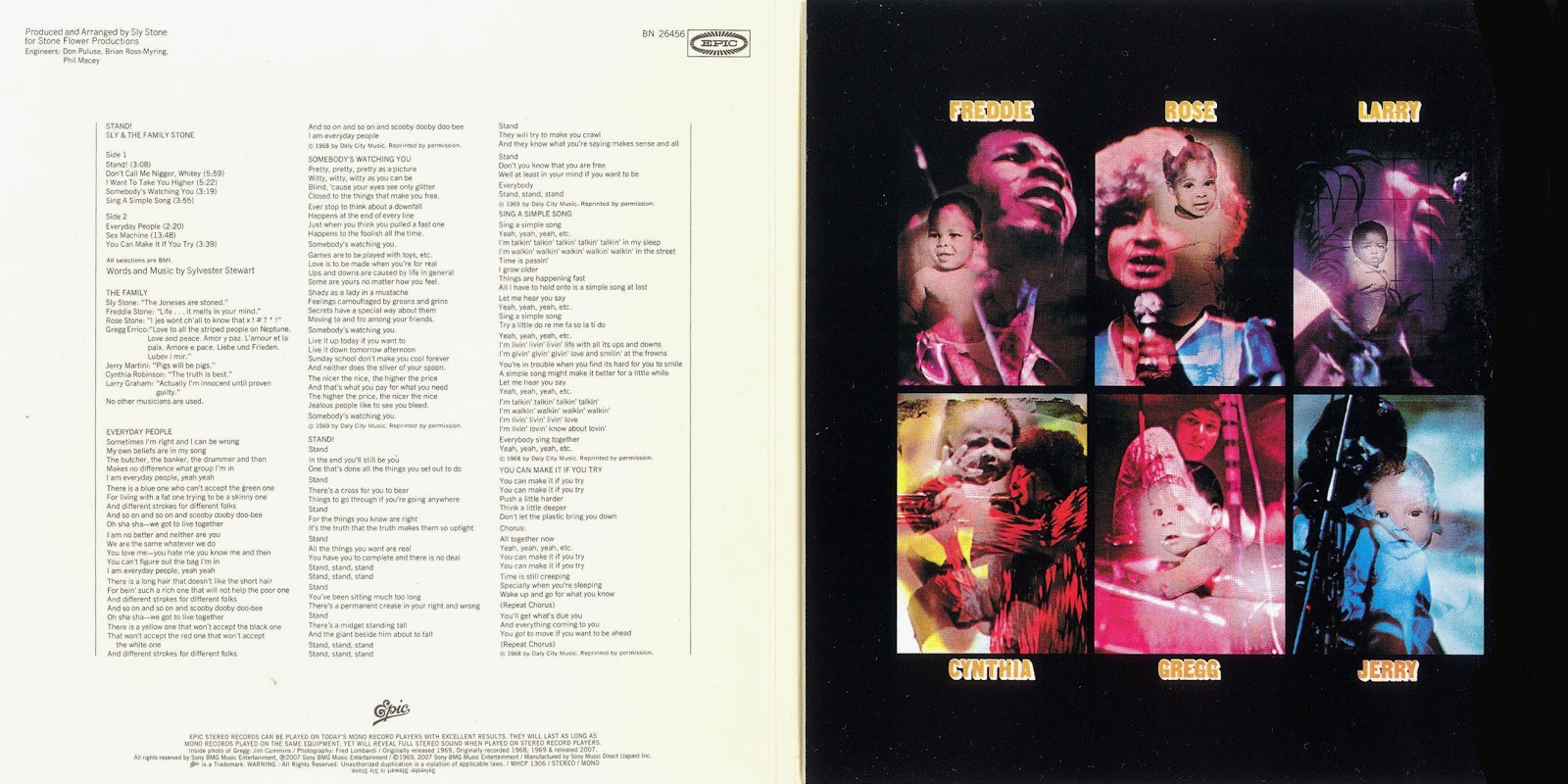
Sly and The Family Stone - Stand! (Psychedelic Soul 1969)

Senin, 28 Januari 2013 0 komentar


Size: 118 MB
Bitrate: 256
mp3
Ripped by: ChrisGoesRock
Artwork Included
Source: Japan 24-Bit Remaster

Stand! is the fourth studio album by soul/funk band Sly and the Family Stone, released May 3, 1969 on Epic Records. Written and produced by lead singer and multi-instrumentalist Sly Stone, Stand! was the band's breakout album. It went on to sell over three million copies and become one of the most successful albums of the 1960s. The album sold over 500,000 copies in the year of its release and was certified gold in sales by the Recording Industry Association of America on December 4, 1969. By 1986, it had sold well over 1 million copies and had been certified platinum in sales by the RIAA on November 26 of that same year. Stand! is considered one of the artistic high-points of the band's career and includes several landmark songs, among them hit singles, such as "Sing a Simple Song", "I Want to Take You Higher", "Stand!", and "Everyday People". In 2003, the album was ranked number 118 on Rolling Stone magazine's list of the 500 greatest albums of all time.

Stand! was recorded after Life, a commercially unsuccessful album. Despite the Family Stone's early 1968 single "Dance to the Music" being a top ten hit in the United States, none of the band's first three albums charted above 100 on the Billboard 200. Stand! broke this trend, reaching number thirteen on the Billboard 200, and launching Sly Stone and his bandmates Freddie Stone, Larry Graham, Rose Stone, Cynthia Robinson, Jerry Martini, and Greg Errico into the pop music mainstream.

Much of the album was recorded in the San Francisco area at studios such as Pacific High Recording Studios. The band’s A&R director and photographer Stephen Paley recalled how "together" Sly Stone was while working on Stand!, down to his constant referencing of Orchestration, a how-to book on orchestral arrangement by Walter Piston. Stone's attitude while working on the album would contrast sharply with the erratic behavior and work ethic he would develop after becoming dependent upon cocaine within a year of the release of Stand! 

Stand! begins with the title track. Sly Stone sings lead on "Stand", which plays out as a mid-tempo number for two minutes before launching into a gospel break for the final forty-nine seconds of the song. Most of the Family Stone was unavailable for the session where Sly recorded the final version of the gospel extension, and he, drummer Gregg Errico, and horn players Cynthia Robinson and Jerry Martini used session players instead. Errico recalls that many liked the gospel extension more than they did the song proper: "People would always ask, 'why didn't you go there and let that be the song?'" The second track on the album is "Don't Call Me Nigger, Whitey", a criticism of racism. The song has very few lyrics, save for a verse by Rose Stone and the song's chorus: Don't call me "nigger", whitey./Don't call me "whitey", nigger. Once "Don't Call Me Nigger, Whitey" concludes, the album launches into the high-tempo "I Want to Take You Higher". Freddie Stone, Larry Graham, Rose Stone, and Sly Stone each take turns delivering the lead vocal. All seven members of the band deliver the shouted backing vocals on the recording, and Sly Stone, Robinson, Freddie Stone, Graham, and Martini are all given instrumental solos.

"Somebody's Watching You" follows "I Want to Take You Higher", and is a somber number about paranoia. Sly Stone, Graham, Freddie Stone, and Rose Stone deliver the song's lead vocal in unison, with the song lyrics reflecting the constant need for a successful person to always have to watch his back. The song's slightly pessimistic tone would be expanded upon later in the band's career with "Thank You (Falettinme Be Mice Elf Agin)" and the There's a Riot Goin' On LP. "Somebody's Watching You" would be covered as a Top 40 hit for the Family Stone's background vocal group, Little Sister, whose version was the first Top 40 single to feature use of a drum machine. Side A concludes with "Sing a Simple Song", which urges the audience to "sing a simple song" and "try a little do re mi fa so la ti do". Motown artists such as Diana Ross & the Supremes, The Temptations, and The Jackson 5 recorded covers of "Sing a Simple Song", and the song's guitar riff can be heard on the recordings of Ike & Tina Turner ("Bold Soul Sister" from The Hunter, 1969), Jimi Hendrix (Band of Gypsys, 1970), and Miles Davis (A Tribute to Jack Johnson, 1971).

"Everyday People", already a number-one hit single in the United States by the time of the album's release, opens Side B. The most familiar selection on the album, "Everyday People" criticises racism and prejudice, and popularized the expression "different strokes for different folks". Sly Stone, Rose Stone, and Cynthia Robinson sing lead on the song, and Larry Graham introduced the beginnings of the slap-pop style of bass playing he would later expand upon for "Thank You (Falettinme Be Mice Elf Agin)". The second track on Side B is "Sex Machine", a thirteen-minute jam, which features Sly again scatting through a vocoder, and allowing each band member an extended solo. Gregg Errico's solo closes out the song; while he was recording his solo, the other band members were apparently standing around him and making fun of him, which is why they are all heard bursting into laughter during the final seconds of the track. Stand! concludes with "You Can Make It If You Try", sung by Sly Stone, Freddie Stone, and Larry Graham. For this track, Sly Stone played the bass instead of Larry Graham.

Stand! is among the most sampled recordings in popular music history; late 20th century hip hop producers were particularly fond of sampling Gregg Errico's drum lines from "Sing a Simple Song" and "You Can Make It If You Try", and either looping the tracks or chopping them up and using the drum sounds. The drums from these two tracks can be found on literally hundreds of hip-hop and contemporary R&B songs, by artists such as LL Cool J, The Jungle Brothers, Digital Underground, Ice Cube, TLC, Jodeci, and many more. Arrested Development, an act heavily influenced by Sly & the Family Stone, borrowed from some of the tracks on Stand! for various tracks on their 1992 debut album 3 Years, 5 Months & 2 Days in the Life Of.... Several 3 Years, 5 Months... tracks contain samples of Stand! tracks, most prominently the vocals samples from the end of "Sing a Simple Song" included in Arrested Development's "Mr. Wendel", their "People Everyday" borrows the chorus from "Everyday People", and the coda of "Fishin' For Religion" mirrors the gospel ending of "Stand".

Psychedelis Soul:
Psychedelic soul, sometimes called black rock, is a sub-genre of soul music, which mixes the characteristics of soul with psychedelic rock. It came to prominence in the late 1960s and continued into the 1970s, playing a major role in the development of funk music and disco.

Following the lead of Jimi Hendrix in psychedelic rock, in the late 1960s psychedelia began to have a widespread impact on African American musicians, particularly the stars of the Motown label. Influenced by the civil rights movement, it had a darker and more political edge than much acid rock. Building on the funk sound of James Brown, it was pioneered by Sly and the Family Stone with songs like "Dance to the Music" (1968), "Everyday People" (1968) and "I Want to Take You Higher" (1969), which had a sound that emphasized distorted electric rhythm guitar and strong basslines. Also important were the Temptations and their producer Norman Whitfield, who moved from a relatively light vocal group into much more serious material with "Cloud Nine" (1968), "Runaway Child, Running Wild" (1969) and "Psychedelic Shack" (1969).

Other Motown acts soon followed into psychedelic territory, including established performers like the Supremes with "Reflections" (1967), "Love Child" (1968), and "Stoned Love" (1970). Psychedelic influences could also be heard in the work of Stevie Wonder and in Marvin Gaye's socially conscious work from What's Going On (1971). Acts that broke through with psychedelic soul included The Chambers Brothers with "Time Has Come Today" (1966, but charting in 1968), The 5th Dimension with a cover of Laura Nyro's "Stoned Soul Picnic" (1968), Edwin Starr's "War" (1970) and the Undisputed Truth's "Smiling Faces Sometimes" (1971).

George Clinton's interdependent Funkadelic and Parliament ensembles and their various spin-offs, took the genre to its most extreme lengths, making funk almost a religion in the 1970s. Influenced by Detroit rock groups including MC5 and The Stooges, they used extended distorted guitar solos and psychedelic sound effects, coupled with surreal imagery and stage antics, especially on early albums such as Funkadelic (1970), Free Your Mind...And Your Ass Will Follow (1970), and Maggot Brain (1971), producing over forty singles, including three in the US top ten, and three platinum albums. [AMG]

01."Stand!" – 3:08 
02."Don't Call Me Nigger, Whitey" – 5:58 
03."I Want to Take You Higher" – 5:22 
04."Somebody's Watching You" – 3:20 
05."Sing a Simple Song" – 3:56 
06."Everyday People" – 2:21 
07."Sex Machine" – 13:45 
08."You Can Make It If You Try" – 3:37

Bonus:
09."Stand!" (mono single version) 
10."I Want To Take You Higher" (mono single version) 
11."You Can Make It If You Try" (mono single version) 
12."Soul Clappin' II" (previously unreleased) 
13."My Brain (Zig-Zag)" (previously unreleased instrumental)

1. Link
or
2. Link
.

Sly and The Family Stone - Life (Classic Funk US 1968)

0 komentar


Size: 85 MB
Bitrate: 256
mp3
Ripped by: ChrisGoesRock
Artwork Included
Source: Japan 24-Bit Remaster

Life is the third studio album by funk/soul band Sly and the Family Stone, released in September 1968 on Epic/CBS Records.

Unlike its predecessor, Dance to the Music, Life was not a commercial success, although it has received mostly positive reviews from music critics over the years. Many of its songs, including "M'Lady", "Fun", "Love City", as well as the title track, became popular staples in the Family Stone's live show. A middle ground between the fiery A Whole New Thing and the more commercial Dance to the Music, Life features very little use of studio effects, and is instead more driven by frontman Sly Stone's compositions. Topics for the album's songs include the dating scene ("Dynamite!", "Chicken", "M'Lady"), groupies ("Jane is a Groupee"), and "plastic" (or "fake") people (the Beatlesque "Plastic Jim"). Of particular note is that the Family Stone's main themes of unity and integration are explored here in several songs ("Fun", "Harmony", "Life", and "Love City"). The next Family Stone LP, Stand!, would focus almost exclusively on these topics.

Just a matter of months after Dance to the Music, Sly & the Family Stone turned around and delivered Life, a record that leapfrogged over its predecessor in terms of accomplishment and achievement. The most noteworthy difference is the heavier reliance on psychedelics and fuzz guitars, plus a sharpening of songcraft that extends to even throwaways like "Chicken." As it turned out, Life didn't have any hits -- the double A-sided single "Life"/"M'Lady" barely cracked the Top 100 -- yet this feels considerably more song-oriented than its predecessor, as each track is a concise slice of tightly wound dance-funk. 

All the more impressive is that the group is able to strut their stuff within this context, trading off vocals and blending into an unstoppable force where it's impossible to separate the instruments, even as they solo. The songwriting might still be perfunctory or derivative in spots -- listen to how they appropriate "Eleanor Rigby" on "Plastic Jim" -- but what's impressive is how even the borrowed or recycled moments sound fresh in context. And then there are the cuts that work on their own, whether it's the aforementioned double-sided single, "Fun," "Dynamite!," or several other cuts here -- these are brilliant, intoxicating slices of funk-pop that get by as much on sound as song, and they're hard to resist. [Wikipedia + AMG]

01."Dynamite!" – 2:46 
02."Chicken" – 2:14 
03."Plastic Jim" – 3:31 
04."Fun" – 2:23 
05."Into My Own Thing" – 2:15 
06."Harmony" – 2:52 
07."Life" – 3:02 
08."Love City" – 2:44 
09."I'm An Animal" – 3:20 
10."M'Lady" – 2:46 
11."Jane is a Groupee" – 2:50 

Bonus:
12."Dynamite" (mono single version) 
13."Seven More Days" (previously unreleased) 
14."Pressure" (previously unreleased) 
15."Sorrow" (previously unreleased) 

1. Link
or
2. Link
.